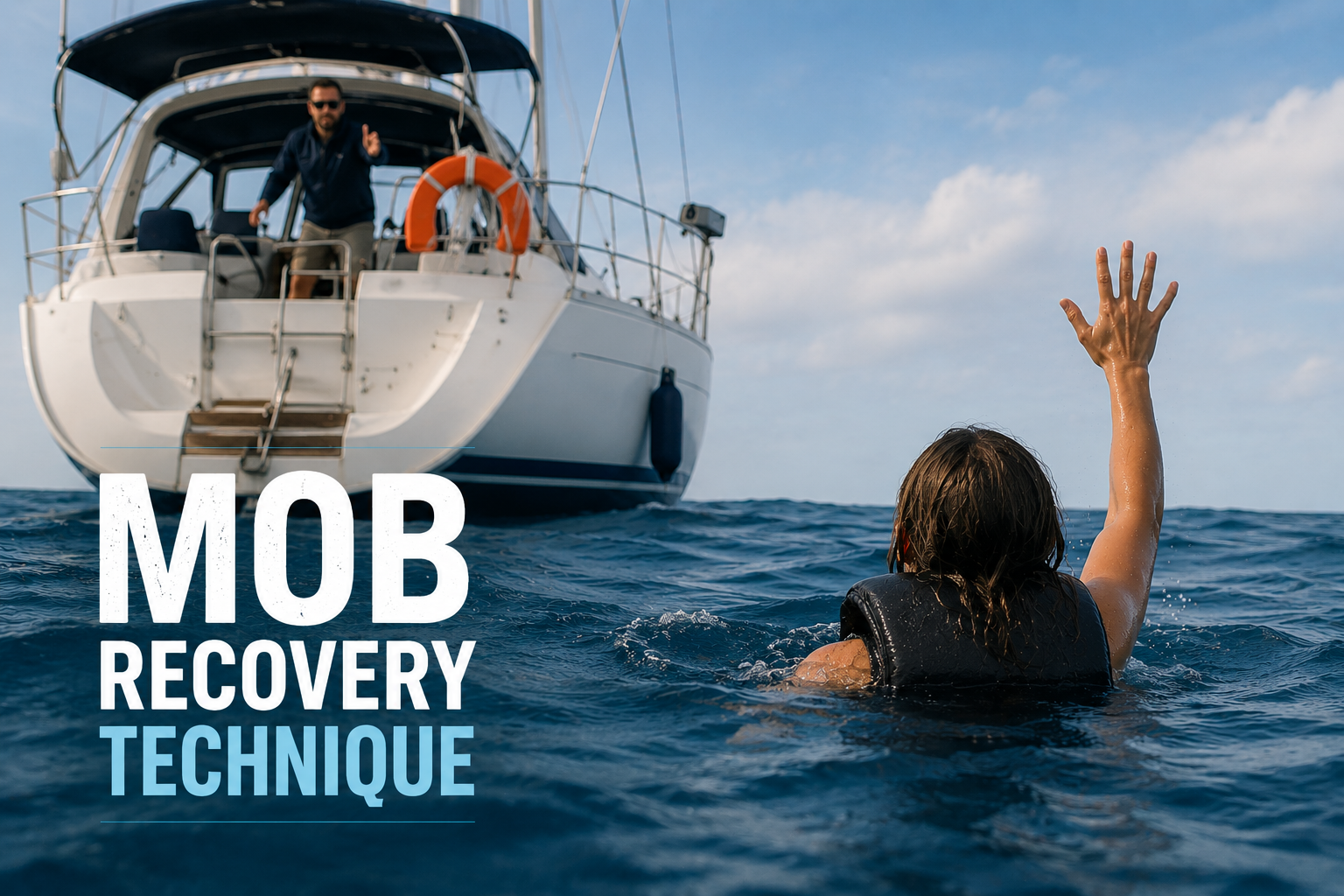
Man Overboard Recovery
Everyone teaches mob differently. The classic is the figure-of-eight. Bear away, tack, come back down, gybe come alongside and stop. It may be doable under power with no sails up but not if you are under sail. I fail to see how you could maintain a lookout, stay close enough to see the mob (especially if it’s at night or there is any weather) and avoid confusing yourself and the crew with all those turns at the same time as dropping sails. To me a figure-eight is a recipe for confusion.
I like Dave O’Conner’s technique. He runs Wild West Sailing on the west coast of Ireland and this simple and elegant method is how he teaches it. The following assumes you’re going upwind when the person goes overboard:
-
Keep going 4 boat lengths close-hauled. In a 12m yacht that’s about 50m and at 5kn will take you about 20 seconds. If you are on a reach then head up immediately but keep sailing those 4 boat lengths and use the time to get organized:
-
toss life rings, seat cushions, anything that floats, and any mob devices you have
-
appoint a lookout to continuously point at the mob
-
hit the MOB button on your electronics
-
appoint someone to send a Mayday
-
start engine in neutral.
-
you can pinch to slow down if you need more time.
-
-
After 4 boat lengths, tack but don’t let go the sheet. You are now hove-to and the boat will stop and start drifting downwind back the way it came.
-
Use the engine judiciously to position the boat so you drift down sideways onto your mob. The boat, especially with sails up, will drift faster than someone in the water. Use a brief forward thrust to bring the bow up into the wind (away from the mob) and a brief thrust in reverse to bring the bow down. Most of the time the engine will be in neutral and your lookout will be pointing directly out, 90° to the boat.
-
When the mob is alongside use a boat hook to help them to the stern platform.
-
If they are unconscious the task will be harder:
-
appoint someone to hold their head above water as best they can
-
if they are wearing a life-jacket with a harness then attach a block-and-tackle (or halyard) to get them onboard
-
if you have enough crew and conditions allow you may be able to lower a dinghy.
-
if you have a SUP you may be able to utilize that
If the mob is conscious then the procedure is simple, it’s easy to remember, and it works. If they are not conscious then it may be challenging to get them back on board, especially if they are not wearing a life-jacket with a lifting point.

Notes:
-
On land if a person is deprived of oxygen then it is generally assumed they are dead after 10 minutes.
-
But in a marine environment the situation is different because cold preserves body and brain function:
-
> 6°C likely dead after 30 mins.
-
< 6°C likely dead after 90 minutes but people have survived 140 mins.
So don’t give up too soon.
-
-
A few things by way of preparation and prevention:
-
wearing a life jacket helps for several reasons:
- it keeps the mob afloat with their head clear.
- it provides a harness with a lifting point.
- it provides a place to store a PLB (Personal Location Beacon).
-
a crane of some type on the aft arch is useful for many things. If there isn’t one then a halyard can be used to lift an unconscious body.
-
A MOB button on the console is useful to mark the initial position, but the mob will drift with current and wind.
-
a Danbuoy or Jonbuoy can help the lookout keep track if thrown overboard immediately. It drifts with the mob and is easier to see.
-
a floating AIS mob device thrown overboard after the event is better as it will drift more-or-less the same as the MOB and show the position on the chart.
-
best of all is an automatically triggered AIS worn by the mob — a PLB device such as the sMRT Alert looks good. These guys also sell life jackets that integrate the beacon.
-